Just a few years ago, at a patient workshop, a woman asked the speaker, “Does a man’s age affect pregnancy outcome?” Surprisingly, the doctor said, “Sperm is like wine – the older the better.” This view is very old-fashioned and just wrong! While maternal age after 35 years is a known risk factor for declining fertility, it has been conclusively demonstrated that sperm DNA fragmentation increases with age.
Clinical Study of Old Age
Studies show that sperm DNA fragmentation increases with age (Wyrobek et al., Evenson and Wixon, 2006). In a clinical study of 17,000 IUI cycles (Belloc et al., 2008) (Belloc et al. (2008) RBM Online 17:392-397), the overall pregnancy rate was 12.7% per cycle but decreased from 14, 4% (men up to 30 years of age) to 8.9% (men over 42 years of age). Importantly, the miscarriage rate increased more than four-fold from 11.1% to 45.6%. This is consistent with data showing that men from couples with a history of two or more miscarriages had 4-fold the amount of sperm DNA fragmentation. (D Carroll) Of course, male sperm DNA integrity varies from person to person. Check which side your husband is on.
Take Action: Perform a SCSA test to determine cause for any of the following matches: age over 40 years and/or history of infertility and/or miscarriage
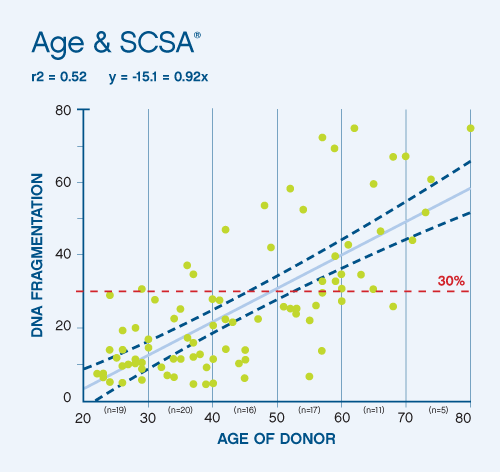
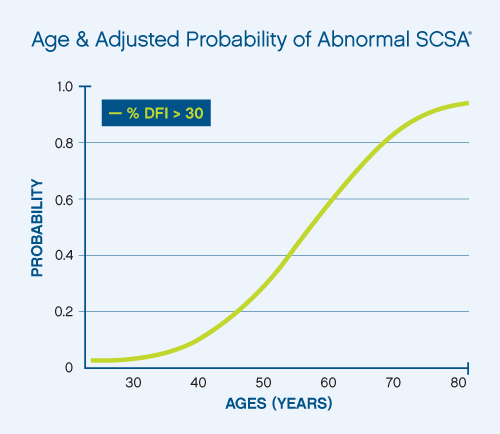
Age & SCSA
- Age correlated significantly (p<0.001) with sperm DNA fragmentation
- Middle-aged males may have normal WHO semen parameters (number, motility, morphology) and high levels of DNA fragmentation